
Seventy-Two Hours of Credits and the Wallet Behind Them
A mining credit is not the same thing as a coin you control, and the gap between the two is where small operators lose track. At 1 PH/s the pool settles 0.00001869 BTC an hour against current difficulty, so three uninterrupted days add 0.00134582 BTC, roughly $113.98 at $84,692 per BTC. This article follows that balance from the moment it is credited to the moment it becomes something you can move.

Key takeaways
- At 1 PH/s, one hour of PPS+ settlement is 0.00001869 BTC and 72 hours is 0.00134582 BTC.
- Credits stay in the pool account until you withdraw, so an unclaimed balance is an operational choice rather than a default.
- Withdrawal timing matters more than withdrawal size when difficulty is drifting and prices move.
- A written rule such as "withdraw above 0.002 BTC on the first Monday" beats a decision made from memory.
Credits arrive on a schedule you never chose
The default settlement method on the pool is PPS+, and its defining feature is that the block-reward component is paid hourly against current difficulty. Nothing about your own luck enters the calculation. You are paid for shares at the rate the network implies, and the pool absorbs the variance of block discovery. That is why the balance grows in even increments even on days when the pool finds fewer blocks than expected.
Compare that with PPLNS, where the combined block reward and transaction fees are distributed after six confirmations across the miner's slice of the pool over the last five difficulty rounds. A PPLNS balance moves in lumps. Some days nothing lands, then a pair of blocks arrives together. Neither method is a promise about total return; they simply place the timing risk in different hands. Which component carries which listed rate is set out on the fee schedule, and it is worth reading before you pick a method. What matters for this article is the shape: PPS+ gives you a predictable trickle, which is exactly the kind of income that gets ignored.
The curve is a staircase, not a slope
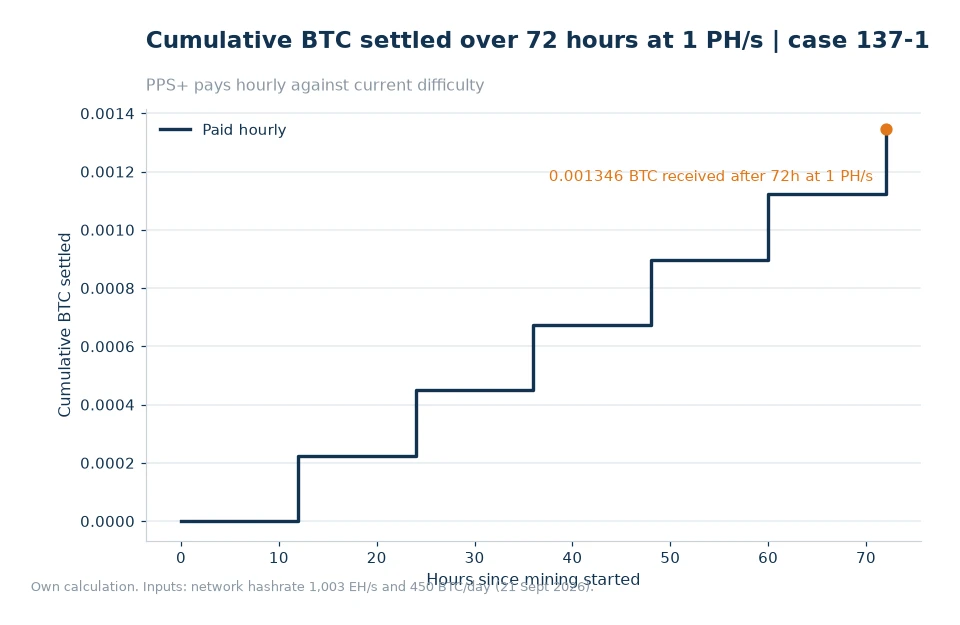
The chart for this piece plots cumulative BTC over three days and looks like a set of stairs. That is not an artefact of the drawing. Each step is one hourly settlement, and between steps the balance is flat because nothing has been credited yet. Over 72 hours there are 72 steps, and the top of the last one is 0.00134582 BTC.
Bookkeeping gets easier once you accept the staircase. A missing step is visible. A short step is visible. If you reconcile monthly and only look at the sum, a two-day outage hides inside a plausible-looking total, particularly when the price has moved in your favour over the same period. Reading the series rather than the endpoint is what turns a mining account into something you can actually audit.
Three habits for a balance that keeps growing
The first habit is to decide what the balance is for. Some miners treat the pool account as a working float: enough coins to cover power and hosting invoices, with the surplus swept out on a schedule. Others let it build toward a specific purchase and withdraw only when the number is reached. Both are defensible. What is not defensible is having no rule at all, because then the decision gets made by whichever week feels urgent.
The second habit is to keep the sweep small and frequent rather than large and rare. Zero-fee mining payouts remove the usual argument against moving coins often, and a smaller transfer is easier to verify against the credit history. The third habit is to write down the price at which each transfer happened. Mining income is priced twice, once when it is credited and once when it is sold, and only the second price affects what you actually keep.
The wallet is the second ledger
Withdrawals land somewhere, and on this platform the somewhere is a multi-currency wallet that sits inside the same account as the mining dashboard. That arrangement has a practical benefit: the balance you see after a withdrawal is the same balance you can spend, convert or hold without another login or another address to remember. The ViaBTC Crypto Wallet supports deposit and withdrawal across the coins the pool mines, which matters if your rigs are not all pointed at BTC.
Treat the wallet as a separate ledger from the pool. The pool ledger answers "what have I earned"; the wallet ledger answers "what do I hold and at what average cost". Mixing them produces the familiar confusion where a rising coin price makes a mediocre mining month look successful. Two ledgers, two questions, one account.
Pick a withdrawal trigger you can defend
A trigger needs three parts: a threshold, a cadence and an exception. The threshold is the balance at which a transfer is worth making. The cadence is how often you check. The exception covers the case where the threshold is met early because difficulty dropped or the price spiked. At 1 PH/s the daily credit is 0.00044861 BTC, so a 0.002 BTC threshold is reached roughly every four and a half days of uninterrupted running.
Write the rule where you will see it. Something as plain as "sweep at 0.002 BTC, check on Mondays, ignore price for the decision and record it afterwards" removes the two failure modes that cost small miners the most: leaving a year of credits unclaimed because it never felt like enough, and moving coins on impulse after a bad week.
| Elapsed | BTC settled | Value at $84,692 | Withdrawal trigger met |
|---|---|---|---|
| Day 1 | 0.00044861 | $37.99 | No, below 0.002 |
| Day 2 | 0.00089721 | $75.99 | No |
| Day 3 | 0.00134582 | $113.98 | No, 0.00065 short |
| Day 5 | 0.00224304 | $189.97 | Yes, on the fifth morning |
Worked example
Start with the network, not the wallet. The chain produced 450 BTC a day across roughly 1,003 EH/s on 21 Sept 2026, which is 450 ÷ 1,003,000,000 = 0.00000044865 BTC per TH/s per day. One petahash is 1,000 TH/s, so the daily figure for this rig is 1,000 × 0.00000044865 = 0.00044861 BTC.
- Divide by 24 for the hourly credit: 0.00044861 ÷ 24 = 0.000018692 BTC.
- Multiply by 72: 72 × 0.000018692 = 0.00134582 BTC, matching the top step of the chart.
- Value it: 0.00134582 × 84,692 = $113.98.
- Take the listed 4% on the block-reward component: 0.00134582 × 0.04 = 0.00005383 BTC, leaving about 0.00129199 BTC if the whole credit were block reward.
- Compare that with a 0.002 BTC sweep threshold: 0.002 ÷ 0.00044861 = 4.46 days, so the fifth morning is the first realistic transfer.
The arithmetic is dull, which is the point. A rule built on it survives a bad week because the number on the screen does not depend on how you feel about the price.
Frequently asked questions
How often does a PPS+ credit appear in the account?
Hourly, against current difficulty. At 1 PH/s that is 0.00001869 BTC each hour and 0.00134582 BTC over 72 hours, before the listed 4% on the PPS-settled block reward is applied.
Should the balance be swept weekly or left to build?
Either works if the rule is written down. Pick a threshold such as 0.002 BTC, which is about 4.5 days of credits at 1 PH/s, and sweep whenever it is crossed rather than at a fixed date.
Does a withdrawal cost a fee?
Mining payouts are zero-fee, so the transfer itself does not reduce the balance; network conditions and the destination address still decide how quickly the coins arrive.
Settle the destination before difficulty moves again
The next difficulty estimate on the read date pointed to a change of about minus 2.12%, which would lift the daily credit slightly rather than cut it. That is a small gift and a reminder: the number in your withdrawal rule is a moving target. Recompute the daily credit whenever the adjustment lands, keep the threshold where it is, and let the cadence absorb the difference.
One more habit is worth adopting now. Export or screenshot the credit history on the day you withdraw, and keep it with the transfer record. When the coins are eventually sold, the cost basis question is answered by that pair of documents rather than by memory. The Profit Calculator will give you the forward-looking daily figure at current difficulty, and the history gives you the backward-looking one. Together they turn a growing balance into a record you can defend.
Sources: ViaBTC pages for fees, the wallet and the profit calculator, covering settlement timing and the listed 4% on the PPS-settled block reward[1]. Inputs as read on 21 Sept 2026 were difficulty 132.76 trillion, about 1 ZH/s of network hashrate, a 3.125 BTC subsidy across 144 blocks a day and a BTC price of $84,692. Published 24 Oct 2026 from figures read 21 Sept 2026; continuous uptime assumed.